Transform Chaos into Clarity with the Problem-Solving Planner
Every designer, entrepreneur, and creative professional eventually hits a wall. You have a complex client brief, a business pivot that isn't working, or a product launch that has stalled. The instinct is often to push harder, but true progress requires a different approach: structured thinking. This is where the Problem-Solving Planner moves from being a simple notebook to an essential part of your creative toolkit. It's not just about listing tasks; it's about building a framework for critical thinking that turns overwhelming challenges into manageable steps.
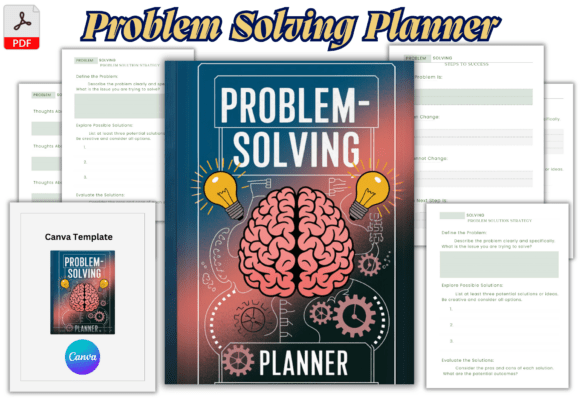
Visually, the Problem-Solving Planner is built for focus. Its clean, minimalist design on 8.5 x 11 inch pages avoids visual clutter, allowing your thoughts to take center stage. The personality is professional yet approachable—think of a trusted colleague who helps you organize your thoughts without judgment. Its style blends the practicality of a business workbook with the intentional whitespace of a premium design asset. The overall appeal lies in its neutrality and structure; it provides the container for your most creative solutions without imposing its own aesthetic agenda.
Where Structured Thinking Meets Creative Execution
The true power of this 82-page planner is its versatility. It’s not confined to a single niche. For the entrepreneur, it becomes the document where you deconstruct a flawed sales funnel or brainstorm a new revenue stream. For the marketer, it’s the space to map out a campaign’s messaging and track its performance against core objectives. Coaches and therapists can use its guided worksheets to help clients identify cognitive patterns and develop actionable strategies. Even for personal projects, like planning a home renovation or organizing a community event, its step-by-step problem-solving worksheets provide a reliable path from idea to implementation.
Consider its application in brand identity work. When developing a logo or visual system, you’re constantly solving aesthetic and strategic problems. This planner can serve as the accompanying journal where you document the "why" behind each design choice, evaluate different typographic pairings, and ensure every element aligns with the client’s core message. It supports the design process by offloading the analytical load, freeing up mental space for the creative work itself. The critical thinking prompts are particularly useful here, pushing you to question assumptions and explore alternatives you might otherwise overlook.
Building a Foundation for Better Decisions
Integrating a tool like the Problem-Solving Planner into your workflow influences more than just task completion. It cultivates a growth mindset. By consistently using its structured templates to evaluate solutions and take action, you train your brain to approach obstacles with curiosity rather than frustration. This shift is perceptible to clients and collaborators. It builds a perception of professionalism and reliability—key components of a strong brand identity. You’re not just a creative who has ideas; you’re a strategist who can execute them methodically.
The included BONUS Editable Canva Template is a significant practical advantage. For designers and content creators, this allows you to customize the planner’s look and feel for your own brand or even rebrand it for clients. This transforms the asset from a personal tool into a potential service offering or digital product. You can adapt its typography—perhaps pairing its clean layouts with a complementary sans serif font for headings or a handwritten font for personal notes—to create a unique version that speaks directly to your audience. This flexibility underscores its value as a commercial font and design resource.
Practical Guidance for Integration
Start by dedicating the "This Book Belongs To" page. This simple act of personalization increases your commitment to the process. When faced with a challenge, resist the urge to jump to solutions. Instead, begin with the identification worksheets. Define the problem in concrete terms. Who is affected? What are the constraints? What has been tried before? This initial analysis is where the planner earns its keep, preventing wasted effort on solving the wrong problem.
As you move to brainstorming, use the critical thinking prompts to generate options without immediate judgment. Then, shift to the evaluation templates. Here, you’ll weigh pros and cons, consider resource requirements, and assess feasibility. This is the stage where you might test different approaches, much like testing font pairings in a design layout to see what resonates. Finally, the action tracking pages ensure solutions don’t remain theoretical. You assign deadlines, note first steps, and create accountability.
Remember, the goal isn’t to fill every page. It’s to develop a repeatable system. Over time, this practice becomes second nature. You’ll find yourself deconstructing challenges more efficiently, communicating your rationale more clearly, and delivering results with greater consistency. For anyone in a creative or entrepreneurial field, this disciplined approach to problem-solving is a competitive edge. It turns reactive scrambling into proactive strategy, one well-defined problem at a time. Download the planner, begin with one current challenge, and experience the clarity that comes from a structured mind.